NaaS Enterprise Strategy Brief

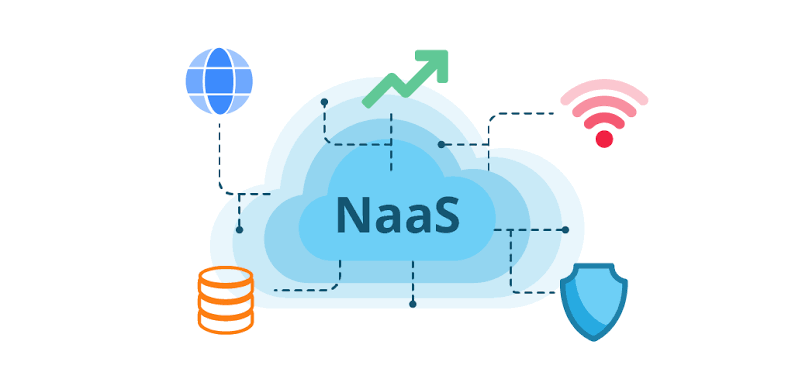
Capital-intensive hardware refreshes strangle agility; enterprise leaders adopt consumption-based Network-as-a-Service to convert CapEx to operational flex.
Legacy network procurement models lock organizations into rigid 3-to-5-year hardware lifecycles, hindering dynamic multi-cloud scaling and branch expansion.
Enterprise teams are shifting toward Network-as-a-Service (NaaS) to deliver cloud-managed, software-defined connectivity with usage-based billing.
Decoupling network capability from physical infrastructure ownership enables enterprise teams to scale bandwidth dynamically while reducing network OpEx by up to 35%.
Modern NaaS frameworks integrate cloud-managed SD-WAN, automated SASE security, and API-driven orchestration into a single elastic subscription model.
⚠ Within the next 3–5 years, enterprises bound to legacy hardware ownership models will face crippling CapEx cycles, severe provisioning lag, and competitive obsolescence.
Designed for CTOs, CIOs, Network Directors, and Enterprise Architects modernizing digital infrastructure.
- CapEx-to-OpEx network transformation
- Automated cloud-managed provisioning
- Integrated SASE & Zero Trust security
- API-driven elastic bandwidth scaling
This strategy brief provides a proven roadmap for transitioning legacy enterprise networks to an agile, consumption-based NaaS operational model.
Enterprise NaaS Transformation Blueprint
Shift from static hardware ownership to a dynamic, cloud-managed connectivity model engineered for enterprise scalability.
✔ CapEx-to-OpEx conversion analysis
✔ NaaS architectural migration roadmap
✔ Vendor evaluation & SLA framework
✔ Executive implementation guidance
Access Intelligence Brief✔ CapEx-to-OpEx conversion analysis
✔ NaaS architectural migration roadmap
✔ Vendor evaluation & SLA framework
✔ Executive implementation guidance